
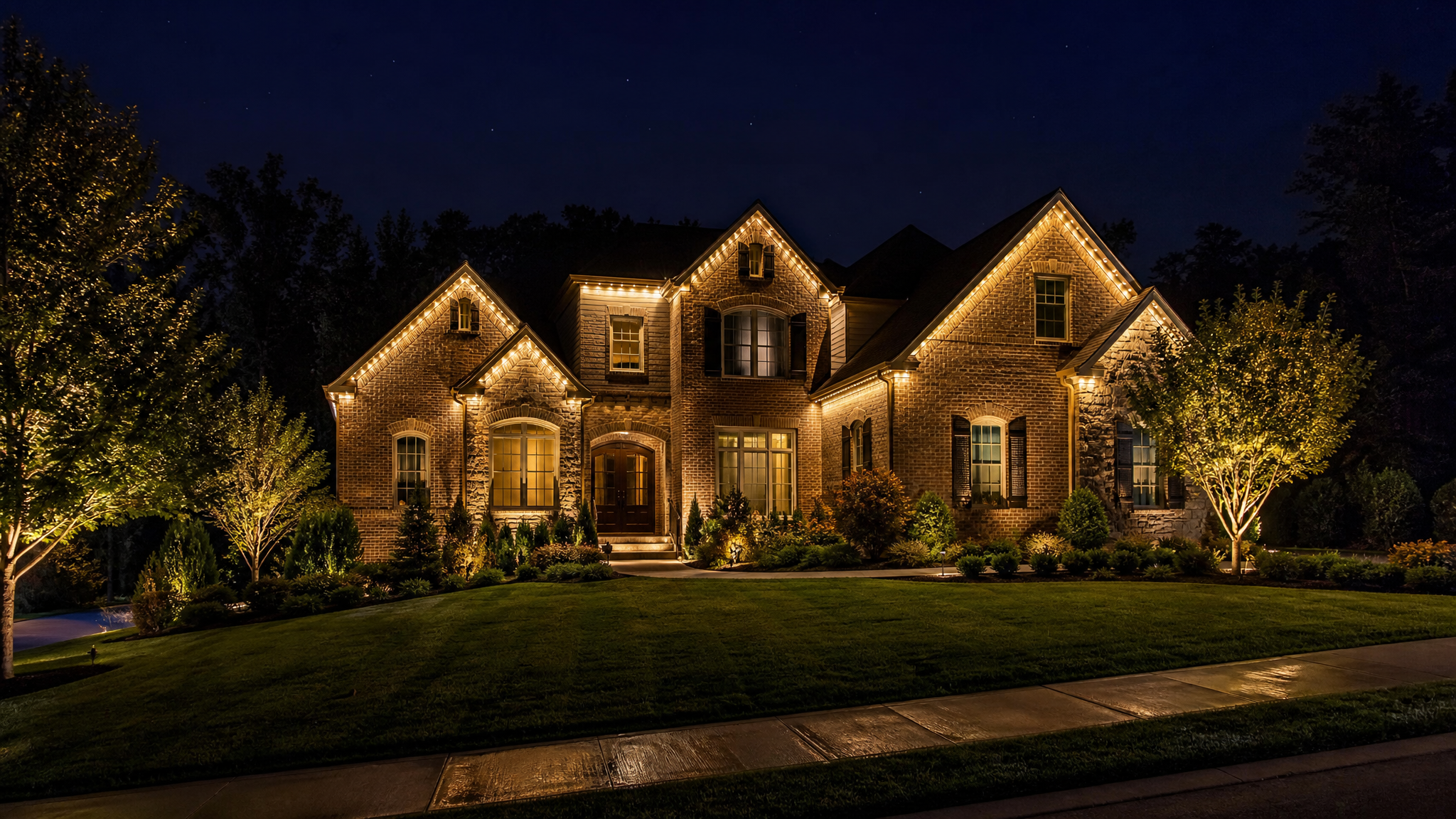
Permanent outdoor lighting and seasonal holiday lighting solve different problems for different homeowners. The honest tradeoff between them covers cost, flexibility, visual character, install timing, and the year round versus seasonal experience.
What permanent outdoor lighting does well
Permanent outdoor lighting eliminates the recurring install and takedown cycle. The system installs once into the soffit, runs every season of the year, and stays available for any holiday or family event. There is no annual ladder time, no waiting for the install window, and no takedown coordination in January.
The programmable color flexibility is the other major strength. The system runs any color combination from a phone app. Christmas red and green, Halloween orange and purple, Independence Day red white and blue, sports team colors for game day, soft warm white for everyday evening curb appeal, custom programs for family events. The programming is the product.
The long service life makes the upfront cost economic over the multi year horizon. A quality permanent outdoor lighting system runs 10 to 15 years. Spread across that period, the annual cost is comparable to or lower than seasonal install for a similar property scope, with the additional benefit of year round flexibility.
The visual character by day is essentially invisible. The channel mount sits flush in the soffit, painted to match the soffit color. The bulbs recess into the channel rather than protruding. The system reads as a clean architectural detail by day and turns into the programmed lighting at dusk.
What permanent outdoor lighting does less well
The upfront cost is higher than the first year of seasonal install. The capital outlay is the single biggest objection most homeowners raise about permanent outdoor lighting. The multi year economics make the upfront cost economic over time, but the first year sticker shock is real.
The visual character by day is also different from seasonal install. Some homeowners specifically value the visual contrast between the bare facade of November and the lit facade of December. Permanent outdoor lighting blurs that contrast because the channel is always present, even if the bulbs are off.
The architectural commitment is permanent. The channel mount is a physical install into the soffit, and reversing the install requires removing the channel and patching the soffit. Most homeowners do not want to reverse the install, but the permanence is a real consideration for homeowners who might move within a few years.
The technology is newer than seasonal install. Some homeowners are more comfortable with the established multi decade history of seasonal install than with a newer LED system that has 10 to 15 year service projections without 10 to 15 year service track records.
What seasonal holiday lighting does well
Seasonal holiday lighting carries the traditional visual character that defines the holiday season. The roofline lights and tree wraps that appear in November and disappear in January are the classic holiday presentation that many homeowners specifically want. The contrast between the bare facade of November and the lit facade of December is part of the holiday experience.
The lower upfront cost makes the install accessible. A single season install is a fraction of the cost of permanent outdoor lighting. The homeowner can try a professional install, evaluate the result, and decide on multi year continuity without a large initial commitment.
The seasonal cycle also fits homeowners who specifically want a fixed holiday window. Lights up the day after Thanksgiving, lights down the first week of January. The defined window matches the traditional holiday calendar and avoids any debate about when the lights should come down.
The visual flexibility year over year is also a strength for some homeowners. A different bulb format one year, a different color scheme the next, a different tree wrap density. The seasonal install allows the look to evolve, where permanent outdoor lighting locks in the channel install pattern.
What seasonal holiday lighting does less well
The recurring annual cost adds up. Over a 10 or 15 year horizon, the cumulative seasonal install cost can exceed the equivalent permanent install. The annual budget line item also has to keep being approved year over year, where permanent install is a one time decision.
The install window is fixed. The crew installs in October or November, the system runs through December and January, and the takedown happens in January or February. The system is not available for non holiday use, where permanent outdoor lighting runs every season.
The ladder time and storage logistics are real even with professional install. Professional install handles the labor, but the schedule still requires homeowner coordination on access, takedown timing, and any HOA coordination. Permanent outdoor lighting eliminates the schedule entirely after the initial install.
The visual flexibility within a season is more limited than permanent outdoor lighting. The lights that go up in November are the lights that run through January. The system cannot change color combinations for specific events without physical reinstall work.
When permanent outdoor lighting is the right choice
Permanent outdoor lighting is the right choice for homeowners who want year round programming flexibility, who plan to stay in the home for at least five years, who want to eliminate the seasonal install and takedown cycle, and who place value on the long term economics of a one time install.
Permanent outdoor lighting is also the right choice for sports fans, families with frequent events, homeowners in warm climates with longer non holiday evening hours, and commercial property owners who want a property asset rather than an annual service.
When seasonal holiday lighting is the right choice
Seasonal holiday lighting is the right choice for homeowners who want the traditional holiday visual character, who prefer a defined seasonal window, who want lower upfront cost, and who want the option to change the install year over year.
Seasonal holiday lighting is also the right choice for homeowners who might move within a few years, homeowners on tight budgets where the upfront permanent install is not feasible, and homeowners who specifically want the contrast between November bare facade and December lit facade.
The hybrid approach
Many homeowners combine both. Permanent outdoor lighting on the main roofline for year round programming. Seasonal holiday install on the trees and the landscape for the traditional holiday warmth in the yard. The hybrid approach captures the year round flexibility of permanent lighting and the traditional seasonal character of holiday install.
The hybrid approach also lets the homeowner phase the upfront cost. Year one might cover the permanent roofline install. Year two might add seasonal tree wraps. Year three might add landscape lighting. The phased approach builds the full property program over multiple years.
What to ask in the quote conversation
The quote conversation is the right place to think through the tradeoff. The franchise crew can produce a multi year cost comparison, walk through the visual differences with example photos, and help the homeowner think through the right choice for the property.
For most homeowners the decision is not strictly economic. The lifestyle preferences, the visual taste, and the property plans all factor in. The franchise crew is the local expert on what works in the specific neighborhood and on the specific property, and the recommendation reflects all of that.